The Communist Manifesto
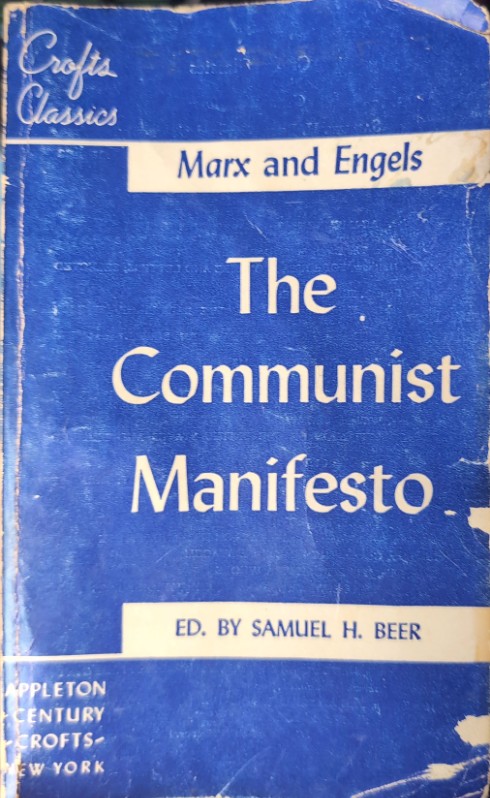
The Communist Manifesto was a tough read at first due to its 18th-century English style. I had to supplement my reading with YouTube videos and conversing with ChatGPT to have a deeper understanding of some terms and background. The first phrase that was thrown around frequently was “Historical Materialism,” which Samuel H. Beer mentioned in the introduction. Historical materialism is a theory that human societies develop and change over time due to material conditions such as food, goods, services, etc., which shape history. Basically, all wars and conflicts happen because of material conditions and that society will develop from one stage to another. For instance, from Feudalism to Capitalism, then to Socialism, and finally Communism.
In each stage, there will be a dominant class. In Feudalism, it will be the monarchy. In Capitalism, it will be the bourgeoisie; in socialism, it’s the proletariat; and finally, in communism, there is no more class, and all resources are shared collectively. My opinion is that, historically, we can see that communist regimes just ended up creating new elites, replacing the old ones with communist-friendly terms (public servants, comrades, etc.). In Orwell’s terms, I guess you can call it doublespeak.
The Communist Manifesto has made me understand the capitalist system better such as the weaknesses and why things are the way they are now. I can see why many countries strive for a balance here by not being too capitalistic and why there’s a clear divide of wealth and power. Balancing it is the tricky part. The welfare and rights of the proletariat must be taken care of and respected, while the bourgeoisie must be kept in check to prevent them from being too powerful in society. For instance, in the first chapter, Marx describes how the bourgeoisie’s expansionist drive leads to global capitalism; once local demand is achieved, it is time to expand elsewhere where there is new demand (colonialism?). Furthermore, it forces least developed countries to subject themselves to more developed countries. Prestigious vocations such as doctors, poets, and scientists are commodified, reduced to wage labourers, stripping their professions of dignity and passion. Without land, tools, or capital, workers must sell their labour to survive, becoming commodified themselves, their worth dictated by how much profit they can generate for the bourgeoisie. Machinery and repetitive tasks dehumanize labour, transforming work into something monotonous and robotic.
In the 2nd chapter, it further highlights the problems of capitalistic society and advocates for the abolishing of bourgeoisie property, especially when it generates profits through exploitation. To the bourgeoisie, education is a tool to control and to prepare workers to serve the capitalistic system. The schooling system is designed to produce disciplined and obedient workers who are trained to follow orders and deadlines. Thus, under communism, education is free and equal for everyone, and it is to free people from ignorance—drastically a different perspective from a capitalistic education system. This chapter also highlights the communist political goals, which are:
Abolition of land ownership by individuals. A progressive income tax. Elimination of inheritance rights. Confiscation of property from enemies of the revolution. State control of banking. State control of communication and transport. Expansion of state-owned industry and agriculture. Universal labour obligations (industrial armies). Fusion of agriculture and manufacturing; break the urban-rural divide. Free public education and an end to child labour in factories.
I had a reflection while reading the manifesto. Malaysia’s history was strongly tied to the fight against communism as well. One of the narratives that was pushed in our history books was that communism promotes atheism, anti-Islam, and rebellion against the monarchy. But, never in the manifesto is atheism or anti-religion sentiment mentioned. This got me thinking, and I dug deeper, and I found a paper that stated the communists in Malaysia’s history were actually anarcho-communists who reject centralised authority, including organised religion (Yong, C. F., 1991).
Altogether, I would say The Communist Manifesto serves not just as a critique of capitalism but also as a lens on how we could do things differently and on the importance of human dignity for every worker. It raises profound questions and realities about power and class, which is an enlightening read. I hope reading this review makes you willing to strike up conversation on the topic.
Yong, C. F. (1991). Origins and development of the Malayan Communist Movement, 1919–1930. Modern Asian Studies, 25(4), 625-648.